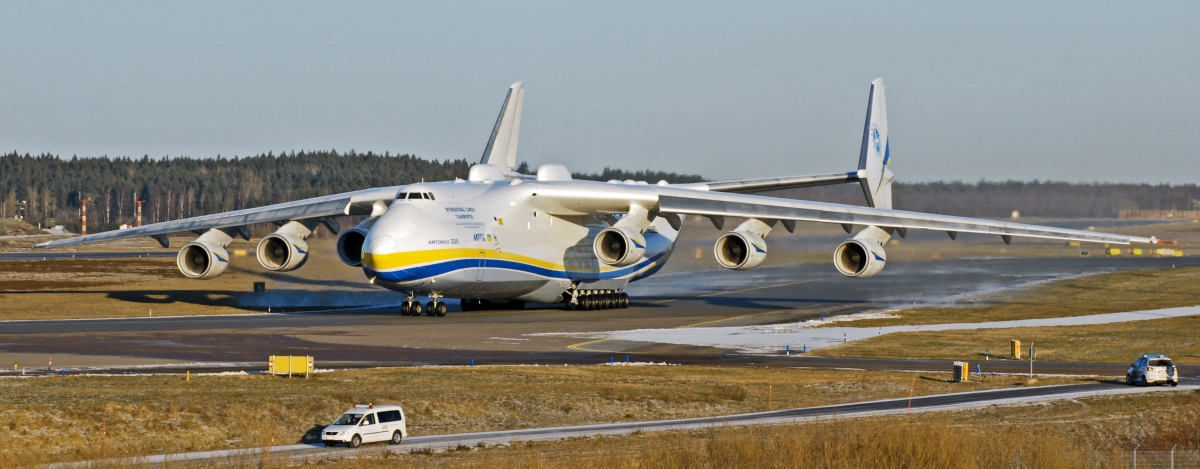
It holds the record of largest aircraft to fly in the world. It weighs a staggering 550 tones. It is so huge that the Wright brother’s first flight could have taken place in its cargo bay. Its 6 engines produce over three hundred thousand pound of thrust making it the world’s most powerful aircraft. It is one of a kind – The Antonov 225.
This gigantic aircraft has dimensions that define beliefs. It also seems to define gravity as it lifts its massive bulk into the skies. It has a wingspan of 88m. The diameter of the fuselage is 19m. It stands over 18m high. This aircraft is so immense that one tractor alone cannot pull it. It needs two heavy duty tractors to tow it from hanger to the airfield. All these measurements add up to one simple distinction. The Antonov 225 is the largest cargo jetliner in the world. This six engine goliath is the heavy weight champion of the world. It’s a jet so long that it will barely be able to squeeze between the goalposts between the football fields.
When it comes to lifting heavy weight cargo, only a few aircraft in the world can handle the loads. The US Air force C17Globe master can lift 85 tones. The mighty C5A galaxy lumbers through the sky with up to a135 tones. But when it comes to mega loads the Antonov aircraft from the Ukraine are in the class of their own. The Antonov 124, the 225,s little brother, if anything this big can be called small has incredible over 150 tons of cargo lighting might.
The Antonov 225 has over 250 tons of cargo lifting capacity. The reason Antonov 225 is the heavy lifting champion is its cargo (hole). Its interior is so cavernous that eight average size houses can be stacked inside. But being the world largest is not the only thing that set this soviet built jet apart. The Antonov 225 is unique. In fact only one of it is in the world.
Antonov 225 has a unique story of its own. A tale of creation, desolation and then a phoenix like rebirth from the economic ashes of the former Soviet Union, the saga surrounding this jet sets it apart from all other jets. The Antonov-225 evolved out of the intense competition with the United States in the race for space. The aircraft was built in the Ukraine in 1988 to carry the soviet space shuttle. The 36 m long shuttle nestled comfortably in its broad shoulders and was dwarfed by the aircraft designed to transport it.
Unfortunately for 225, size was not everything. In 1989 the Berlin wall fell and by 1991 Soviet Union was history. Not even size could save the Antonov 225 from the economic woes of a country in transition as space program was cancelled and the jet was decommissioned and demoted in the biggest scrapheap of the world.
They parked the aircraft in the corner of the test facility at Gostabel and watched the wonderful asset falling into disrepair. It was after a decade that the Antonov 225would cancel the odds and fly again. The world’s largest aircraft carries the name of its creator.
The name of a man whose passion for the flights began in the days when Sir Nicholas the 2nd, ruled Russia as the last emperor and aviation was at infancy. Ola Constantinovich Antonov was born on Feb. 7th, 1906 near Moscow, just three years after the Wright brothers made their famous flight at Kitty hawk. As his country weathered World War I and then the Russian revolution, young Antonov turned his heads to the clouds. He collected World War-I airplane parts and this fascination with flights let him to design his first glider. Ola Antonov build his first flying machine in 1923 in age 17, it was a glider. Ola Antonov graduated in 1930. He then worked as the chief of design at various soviet factories developing more than 30 types of gliders. He was a very talented engineer especially in aerodynamics.
The world’s first wide body aircraft was developed in 1965, the Antonov 22. To this day the Antonov 22 remains the biggest Turbo-prop plane in the world. Approximately 100 of these massive military transport planes were produced. Then comes the ironically named little brother to the biggest jet in the world, the Antonov 124.
It was developed in the mid 1970s as a strategic air transporter to the soviet military to carry missiles and tank. With its 73m wingspan and 69m length, it easily captured the record for the largest production aircraft in the world. Over 60 of these jets have been built and Ola Antonov led the initial design work. Within the government there were conflicts of opinion on design but Antonov prevailed.
Notable features of his giant creation were thicker wings than its predecessors providing more lift and fuel capacity. The aircraft had nose and tails cargo doors allowing vehicles to drive in one side and out the other. The jet had the ability to kneel down on its undercarriage making for easier front loading and had its own internal crane to pick up cargo at the rear, carry it straight into the aircraft and places it wherever needed.
The 124 excelled at going in places where normally jets wouldn’t go. It could use its gigantic landing gear to nimbly touchdown anywhere needed, even on unpaved runways.
The first prototype flew in December 1982, and by 1984 the airliner was in production. Ola Antonov legacy to build big was reflected throughout the Soviet Union. Bigger was always better. Since the cold war competition with the west was fierce and Antonov designers always strived to outdo the Americans.
At all times they competed with United States in transport aircraft. The competition was so intense than the race for space between Russia and United States. The soviets were developing their own space shuttles called Burran which means snow storm. In design it looked similar to America’s space shuttle.
By the mid 1980s the soviets space program has fallen behind schedule and they were desperate to keep up with Americas program. The soviets lacked a vehicle large enough to transport Burran. In 1985, design began in Antonov 225. It was necessary to create a design reliable enough to carry to space shuttle from the manufacturing plants of the Soviet Union which were located a long distance from the launch pad.
They wanted to build the Antonov 225 fast and on a tight budget. They had very strict requirements to construct the aircraft as quickly as they could and with little expense. The United States already had their space shuttle. The pressure was massive for the Antonov design bureau. So they decided to modernize the Antonov 124, to upgrade it and use the 124’s existing assembly and parts to create a bigger and more effective jet to transport the space shuttle.
Nicknamed Maria, the Russian word for dream the Antonov-225, grew from the technology that had built its little brother, the Antonov-124. Looking at the 225, it had many similarities to the Antonov 124.
The wing panels of the Antonov-225 are actually identical to the Antonov-124 and the engines are too the same. There were six, instead of four as in Antonov-124. But using the Antonov 124 existing technology was not enough. Radical design changes had to be made; most of them have to do with size and power. There was a change of a tail unit. One fin tail was used to compensate the aircraft. The numbers of landing gears were increased to 32 total tyres including front landing gears. The designers for this plane were only given 3 and half years to design this gigantic new jet and get it off the ground. Initially the engineers couldn’t even find the place big enough to build the aircraft.
There was a problem in finding a place to construct the aircraft as it would not fit in any existing facility. Again the jets size was continuing to cause other problems. The 225 was designed to transport gigantic cargos and the jet needed to be able to land. They had great problems with landing gear. They faced the problem of creating the aircraft with a takeoff weight of 600 tones they would also be able to land on unprepared airfields. The landing gear had to be made in such a way that it would not break the runway. The designers came up with a solution adding a massive bank of landing gear on the Antonov 225. Its 32 tyre burn rubber every time this 600 tones behemoth touched down.
The aircraft flew first on December 1st, 1988. Those who had initially thought that the Antonov-225 cannot fly, suddenly experienced the change of heart when as the aircraft began its historic first flight. Everyone felt very proud when it flew. Within months of its maiden flight, the Antonov-225 broke a hundred and nine records for its range, altitude and cargo capabilities.
Finally in 1899, the aircraft completed the mission it was designed for. It flew with the 90 tons space shuttle, the Burran attached to it externally for the very first time. With the Burran attached to its back, the Antonov 225 made its debut before a worldwide audience at the 1989 Paris airshow. Antonov stole the show.
The Antonov’s-225, bulk and strength quickly captured the imagination of the world. There were even proposals to turn the Antonov into a flying cruise ship. They also calculated the feasibility to carry people and technically it could carry 1500 people. The Burran only ever made one space flight and the 225 had only been airborne for a few short years when an event took place that changes the world forever. It also grounded the future dreams for the Antonov 225.
In 1991, the Soviet Union collapsed and the Soviet Union’s space program which included the Antonov 225 lost its financing. The soviets union’s space program was cancelled due to lack of funds. The king of the sky became a trash metal box. Its parts cannibalized for other jets. The only 225 in the world was grounded due to lack of funds and it stayed idle for 8 years. With the fall of the Soviet Union, the Antonov design bureau was facing bankruptcy. They started tomarket the Antonov 124 which allowed them to carry outsized and heavy cargo.
The Antonov was transporting everything from PowerStation generators to motor racing crews, cars and equipments to points all over the world. By the late 1990s the Antonov Company was receiving requests to carry loads weighing more than 150 tones which was the maximum carrying capacity of the Antonov 124. Opportunity was calling for the Antonov 225and its massive capacity but it was rusting in a nearby field. All of that heavy cargo could be easily carried by Antonov 225 and the company chose to refurbish the 225, after years of being grounded.
Also the management decided to make its second debut at the Paris air show but after sitting for idle for 8 yrs, the 225 would need extensive restoration before it could fly again. The primary section of the aircraft was reinforced especially the floor and nose section of the fuselage so that it could transport large cargo up to 250 tones.
For full range, the jet must carry over 2,88,000 litres of fuel, an amount that would fill 6000 average size cars. It also burned the fuel at a staggering rate of 18 tons an hour and depending upon the weight of the load, it has the potential range of over 12000 kms. That’s the distance between New York and Hongkong.
With 20 million dollars spend in upgrading the 225, on April 2001, after being grounded for 8 yrs, the 6 engine goliath made its 2nd maiden flight. With the world’s largest cargo plane flying again, the Antonov design bureau made plans to take every advantage of the Antonov-225.
The aircrafts potential was not only the weight of the cargo that it could carry but also the size of the cargo. Its 43 m long hall, could swallow upon entire fuselage of Boeing 737.
After getting certification as a commercial jetliner, the Antonov-225 again arrived at the Paris air show and as before the mighty jet fascinated all who saw it. When the Antonov-224 eventually thundered down the runway and took to the skies, the people at the Paris air show were not just witnessing the rebirth of the biggest jet in the world; they were seeing a handful of workers from a former Soviet Union take flight into a new economic world. Transformed from a giant of the cold war to a commercial giant, this massive jet is ready for the massive duty ahead of transporting heavy cargo around the globe.
