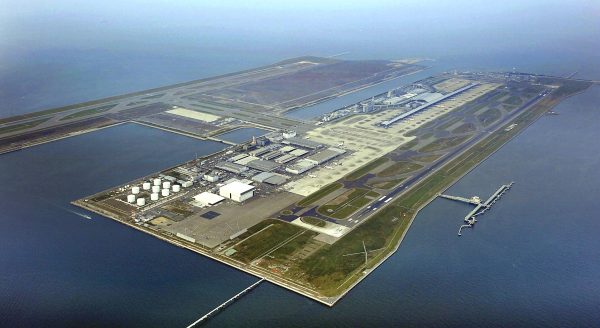

Where do you land a plane in a land that has run out of space? Japan’s answer, Kansai International Airport, a floating mega structure built to withstand the wrath of mother nature from above as well as down below. This is an amazing island airport in the land of the rising sun that may be destined to sink back in to the sea. Osaka, the ancient capital of Japan, in order to compete with their big sister Tokyo, needed to find a way to bring in new people with the intention of big business. They needed much bigger airport to open up the sky. But government officials resteled with the question of big proportion and where an airport could be built, one that is large enough to meet the demands of the day without noise pollution. Also, Japan is an island the size of California and the area is partially mountainous and heavily populated making it impossible to find an open space to build an airport in Osaka. So instead of moving mountains, officials decided to climb one, creating a plan to build an airport unlike any other. Their earth shattering decision came from a thought of landing planes off shore in case of in availability of space to land them on shore. The problem was, building the space first! In 1987, construction of the world’s biggest manmade island of its time started 18 meters deep, in the middle of Osaka Bay. Seven years later, the world had its first international airport floating out in the middle of the sea, all by itself, a true oasis for pilots. Kansai features the latest trend in airport construction. It is built on a made island in the middle of the ocean. Kansai is a response to the overwhelming need for more airport services in a place where encroaching urban population and lack of available land makes a big, noisy, downtown airport undesirable. Kansai is one of Japan’s busiest air hubs that is open 24 hours a day. Kansai is recognized by the world as one of the most incredible engineering marvels of the 20th century. It is also compared to the mega structures like the Hoover dam and the Panama Canal and was built 5 km from the shore with an area that is more than the whole downtown area of Osaka. Connected to the mainland by the longest two tier bridge, Kansai welcomes more than 55,000 planes a year, a unique experience for both the pilots and the passengers, making what appeared to be a liquid landing. Building Kansai created a real life parting of the seas and was a construction of mega proportions. It’s the largest public work undertaking of the 20th century costing more than $15 billion US dollars, with over a million workers putting in around 10 million hours of work. To pave the way for the textbook landings for today, Japanese engineers had to rewrite the manual on how to build an airport. The biggest challenge was to manage the entire manpower and open the airport as scheduled. It was a balance between the engineering for the land fill and construction on top of it. And speaking of balance, there was a problem as to how exactly would an artificial island hold up to all the pressure above without collapsing into the spongy sea bed below? Never before had anyone attempted a massive landfill project so far from shore and so deep in the water. Both would pose potential problems. Also the fact that there is a deposit of clay in the bottom of the Osaka bay could not be ignored. The bottom of Osaka Bay is made of soft spongy clay that’s likely to sink. Not really the kind of stuff you would top off with an airport runway. That’s like landing a 340 tones jumbo jet on a huge plate of tofu. To solve this problem, Kansai engineers turned to a new sand draining technique to actually speed up the sinking by sucking the water out of the sand for the airport foundations. They always had faith in their engineering and that’s been the backbone for the project. Confident in their techniques, Kansai engineers set aside any of their own sinking feelings with a plan to best the sinking by throwing extra layers for good measure. And with that, the six year process began. First, 11 km of sea wall of concrete blocks outlined the shape of things to come. Then 80 barges dumped in more than 180 million cubic meters of landfill inside the sea wall. That is about the size of the great pyramid, 70 times over. Using the technology of the time, builders monitored and measured the layering of the land, making sure the fill was compacting at an even rate to prevent uneven sinking. And just when the face of the island started to pop out of the water, construction began simultaneously on two major airport landmarks. Kansai’s passenger terminal proved to be an architectural miracle that amazed even the best builders; a wind shaped terminal made of steel and reinforced glass. Exactly one mile long, Kansai’s signature structure is one of the largest single roomed buildings in the world. The next crucial challenge in completing the airport was the ultimate question of access. Because if you stick an airport in the middle of the water, how on earth do you get delivery trucks packed with goods loaded with luggage in and out efficiently? The answer came along with the construction of the Skygate Bridge. With the use of floating cranes, workers built each of the peers one at a time, cementing the pieces together like a giant toy building blocks. At 3,750 meters long, it carries six lanes of traffic on top and two trains below, just high enough for boats to pass under, yet low enough for jest to fly over. Finally after seven years of drilling, dumping and designing, the aerodynamic airport opened for business on 4th September, 1994. In the first month alone 10,000 people came to the airport everyday. In its first years of operations, Kansai International Airport fulfilled its promise to becoming a new gateway to Asia, flying high with thousands of travelers impressed with Kansai’s engineering. However, when dust from the massive construction project settled, words began to spread otherwise. The airport was sinking and dropping a little faster than the planners had expected. During construction, the sand draining appeared to take care of strengthening the base first level of soft soil that would help accelerate any potential sinking. But it was the deeper stuff, the soil that they couldn’t drain which would soon become a problem. By 1999, on Kansai’s 5th birthday, it became apparent that the entire island had already sunk over 8 meters, ageing the airport 40 years ahead of schedule. There were questions regarding the sinking, whether it would stop or whether the whole island would sink. And also what did this sinking down below meant to the structures up above. According to Kansai officials, the soil settling was slowing down significantly with the uneven sinking becoming less frequent. The Kansai engineering team was so confident in their triumph over the ocean that they built a second island with a second runway. They were already on shaky grounds and Kansai sits in middle of the volatile land prone to natural disasters called the pacific rim of fire, home to earthquakes, tidal waves, some of the worst weather on the planet, frequent typhoons and earthquakes in the country. These factors were taken fully into consideration during the design phase. In 1995, with the airport only opened for fifteen months, an earthquake measuring 7.2 rector scale hit the nearby city of Kobe, the epicenter just 29 kilometers from the airport island. However the damage done by the earthquake was not very severe apart from some small cracks. While the city of Kobe was severely damaged, the advanced structural design of Kansai’s terminal building stood strong, perhaps proving to Kansai’s critics that all those ground preparations would also help keeping the airport at bay. The minute your plane lands on the tarmac and rolls into the gates of Kansai International Airport, you would begin to get an idea of the number of people it takes to keep this airport afloat. It takes lot more than a village to keep Kansai running smoothly and safely. Kansai’s unique location in the middle of the ocean means that this island gateway needs to be totally self sufficient with an infrastructure more like a city than an airport. Each day thousands of passengers pile on to this floating metropolis. While Kansai is a real city on the sea, the main drag is its 3,000 meters runway, an asphalt that welcomes over 200 planes a day. Maintaining this is critical to airport’s entire operation as even a small pot hole or one broken light in the runway can shut down the business. But finding time to maintain the runway can be tricky specially when it is open and running 24 hours. So, the workers do it at night in between flights, as it easier to spot the one problem light out of 5000 that are in the runway. Also, like any other airport, providing jet fuel is a necessity. This is the task in which Kansai proves to be an ideal place because being in the sea mean tankers can provide jet fuels very easily. Kansai also has a clean center that is one of a kind, handling all the trash coming off the planes and out of the terminal with their “Keep it clean and green” mission. Their main job is to minimize the amount of trash and also try to recycle it as much as possible. The signature building of Kansai Airport terminal provides a travel experience that seems to fit its unique location in the middle of the sea. It’s an airport island paradise for passengers and pilots. With the addition of another runway, Kansai officials hope that planes from all over the world will have much more to be fond of. In 2004, Kansai celebrated its 10 years of operation as Japan’s new portal to the pacific, welcoming travelers from around the world. While bigger carriers like United are adding services to Kansai, some international carriers have already pulled their stakes off struggling to pay the high landing fees of Kansai. It’s an unfortunate dilemma for today’s cash strapped airlines. Landing fees not only reflect the number of flights but also the value of airport property. But there is no other way to land here without the extra costs because in its absence their hands and their wings may be tied, forcing them to divert their planes to cheaper Asian airports of South Korea, Sanghai and HongKong.
As time goes on, Kansai officials don’t just want to be remembered as Japan’s sinking airport heading them to the same direction as the Leaning tower of Pisa but as the one successfully operating on a huge `landfill that the world knows.
