If you are aviation professional, chances are higher that you will know this term. But even if you are not, don’t worry, we got your back. LAME or shall we say, License Aircraft Maintenance Engineers are those professional who have Aircraft Maintenance Diploma or degree along with the licence. Now what is this license? Let’s get our hand around it. Shall we?
If you are looking forward to get to the technical side of Aviation, the most proffered job would be Aircraft Maintenance Engineer. True there are other technical departments too like Planning, Quality, Procurement Assurance but looking at the scenario of the country these departments normally does not have regular hiring. And the young bloods are preferred more on line maintenance.
Even if you have Aeronautical Engineering or Aerospace Engineering, Nepalese aviation will prefer you in keeping in Aircraft Engineering Maintenance department. The point is Nepal do not have research, design and production of aircraft, so the degrees like Aeronautical/Aerospace is not preferred. Getting back to the topic, Aircraft Maintenance engineering- once a student graduates with a degree or diploma, the students are required to take Aircraft Maintenance Engineering license test, if s/he really wants to take his career forward.
What is AME license? Well, back then Civil Aviation Authority of Nepal has its own licensing rules and regulation. We had different papers namely Aerodynamics, Aircraft Systems, Gas Turbine Engine etc.
But in recent days, CAAN has implemented licensing rules of European Aviation Safety Agency (EASA) and the licenses popularly called Part 66 or EASA part 66. Part 66 licence is required for engineers to obtain ‘approvals’ to work on aircraft. These approvals are issued by companies who are themselves approved by the CAA (EASA Part 145) usually after ‘type training’. The approved engineer can sign off work on the aircraft within his/her license authority. So for anyone who aspires to work on civil aircraft as maintenance engineer the Part 66 is a must. This means passing all the modules that go to make up that particular license.
The license categories are:
Category A
Line mechanic
(Airframes and engines)
Category B1
Licensed engineer
(Mechanical, airframes and engines)
Category B2
Licensed engineer (avionics)
Category B3
Licensed engineer (piston engine aircraft of mass 2000kg and below)
Category C
Licensed engineer
(Base maintenance)
Let’s see what this category is. Starting from Category A, the following are the sub-categories within
Licence A:
Category A1
Turbine Engine Aeroplanes
Category A2
Piston Engine Aeroplanes
Category A3
Turbine Engine Helicopters
Category A4
Piston Engine Helicopters
Category A5
Reserved for Airships (to be developed)
To be eligible for a license, an individual must have completed the relevant modular examinations and have a prescribed period of aircraft maintenance experience. A minimum of Grade C GCSE’s or equivalent in maths and a science subject is required.
Practical maintenance experience will also be a benefit, in both assisting understanding and ensuring all experience requirements will be fulfilled within the specified 5 year period. Once passed, the modules are held in credit for 5 years. All experience and relevant examinations must be gained within this time period, otherwise module examinations will have to be retaken. The course must be followed by a minimum of 1 year’s practical experience to consolidate the training received. The total experience requirement is a minimum of 3 years in maintenance of operating aircraft.
Category B
The licence is issued after passing all the appropriate modules and obtaining the appropriate experience. Allows the engineer to sign the Certificate of Release to Service for the aircraft in the category for which he/she is licensed.
Experience required (gained within the 10 years preceding application):
At least 1 year of the experience shall be recent experience gained on aircraft type for which application is to be made.
Category C
Requires 3 years experience as a B1.1, B1.3, or B2 engineer or 5 years as a B1.2 or B1.4 engineer.
There are no experience requirements to be allowed to sit the examinations; they apply only when licence application is made. As the individual module examination is being passed, it has a life of 10 years. It is important that all the exams for a particular licence are passed within 10 years of passing the first module.
All the above experience requirements must include one year’s recent experience and that experience must include equipment for which application is made. In other words if you are applying for the B1.1 licence mechanical jet engine aircraft the one year recent experience must be on this type of aircraft – not on helicopters.
The EASA Modules
The syllabus for these is published in the EASA Part 66, which is issued by EASA as an official publication of the EU.
Note that for licences A, B1, B2 and B3 the level of some module examinations is different.
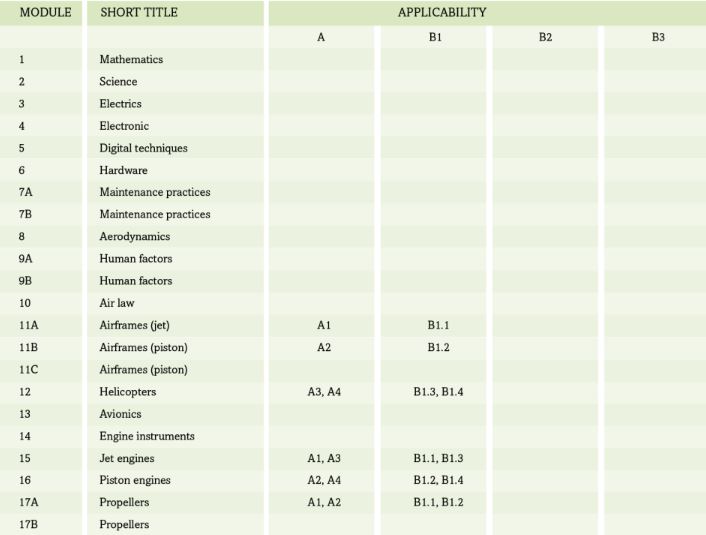
Note that, in the following table, shortened titles are used to save space.
Modules Required
For Category A licence – modules 1 to 6 except module 4, plus modules 7A, 8, 9A and 10 plus:
A1 11A, 15 & 17A
A2 11B, 16 & 17A
A3 12 & 15
A4 12 & 16
For Category B licence – modules 1 to 6, plus:
B1.1 7A, 8, 9A, 10, 11A, 15 & 17A
B1.2 7A, 8, 9A, 10, 11B, 16 & 17A
B1.3 7A, 8, 9A, 10, 12 & 15
B1.4 7A, 8, 9A, 10, 12 & 16
B2 7A, 8, 9A, 10, 13 & 14
B3 7B, 8, 9B, 10, 11C, 16 & 17B
Notes
- The first 10 modules are common (except for module 4 for the category A person). However, the exact content of each exam for a particular module will vary depending on what licence the engineer is aiming for.
This means that for the A person, parts of some modules are not examined on at all and other areas are taken at a lower level than the B level. For the B person (in very general terms) the differences in the level of difficulty in those modules where there are differences are:
MODULE THE HIGHER LEVEL IS THE
1 B
2 B1
3 B1/B2
4 B2
5 B2
6 B1
7A B1 but B2 for item 7.7
8 B1/B2
9A B1/B2
10 B1/B2/B3
- The above is not significant (assuming you take the examination to the correct level for the licence you areaiming for), unless you intend taking another licence after you have obtained the present one.
For example: If you are going for the B1 and intend taking the B2 at a later date then it would be prudent to take modules 4 and 5 as a B2 examination (the higher level). If you are presently going for the B2 and plan to eventually go for the B1 then it would be wise to take modules 2, 6 and 7 at the B1 level. The levels of modules 1, 3, 8, 9A and 10 are the same for both B1 and B2 examinations.
- Some of our modules (6 and 7A for example) we have managed to split into B1 and B2. When ordering ensures that you order the correct module.
- For those modules we have not split into B1/B2, and then they have been written to the higher level in each case.
- The CAA examination consists of a multi-choice paper for each module and an essay paper for modules 7, 9 and 10.
- For CAA examination purposes the modules can be taken in any order (including the essay papers), though there are too many to be taken all in one day. Unless you have a long way to travel it would be better to take the bigger modules one at a time and the smaller ones either single or in twos or threes.
- It is generally considered better to take the essay exam for module 7 when doing the multi choice paper for module 7, with the same principle applying for the essay papers for modules 9 and 10. Remember, in all cases there is an exam fee payable for both the essay paper and the multi choice paper. (If the essay questions are all taken together then there is one fee payable.)
- Suggested sequence for taking the modules. Take 1 to 5 in order. Take 6 and 7 together at any time. Take 8, 9 and 10 at any time in any order. Take the ‘trade’ modules last (11 to 17).
- There are almost no exemptions allowed against any of the module examinations. Certain degrees will attract exemptions to some modules – for details contact the CAA.
Remember. The modules, once passed, have a life of 10 years so if you do not complete all the modules in 10 years you will start to lose the first modules passed.
Applicants must be at least 18 years of age. These were the basic of part66 license. Next we will be discussing more on licensing procedure. Till then stay tune.
