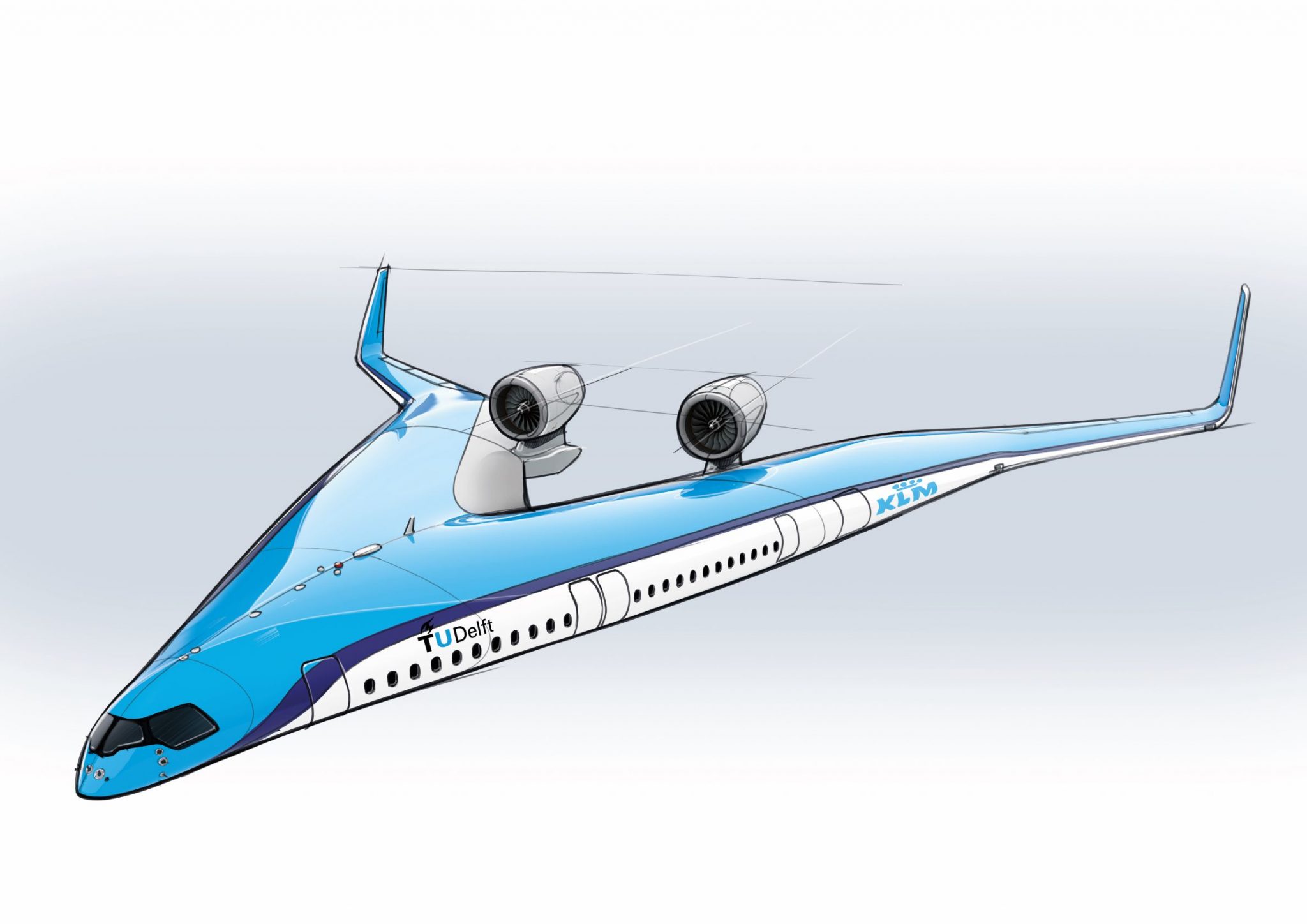
With the growing technologies, lots of unique and advanced development has been taking place. Not only on automatic machines and robots, today airspace has also started creating its unique airplane. Based on the v-shaped structure, researchers at Delft University of Technology (TU Delft) have designed a new aircraft with the motive of reducing carbon emissions. Moreover, the idea for a sustainable aircraft that holds passengers, cargo, and fuel tanks in its wings started with Justus Benad, who was a student at Berlin’s Technical University at the time.
The flying V-shaped aircraft offers an more innovative and sustainable way of flying where the plane is named after the Gibson Flying-V electric guitar used by musicians such as Jimi Hendrix and Keith Richard. The flying V project has been helped / funded by Dutch Airline, KLM for its final manufacturing and its scale model is expected to fly on October at Amsterdam Schiphol Airport for the first time. However, for the commercial service it is expected to take more of 20 to 30 years. The major aim of bringing this type of design aircraft has been to develop one of emission-free flight which is said by Henri Wrij ean of the Faculty of Aerospace Engineering at TU Delft.
The plane is designed in such a way that passengers would be able to sit inside the wings which none of the planes have the capacity of doing that. The concept of a place shows the traditional bird-like design – long fuselage, wings on both side and instead making the wings the aircraft’s chief storage space. The aircraft is said to be of the same size as of Airbus A350 but is not long as A350 and also consumes 20% less fuel than the conventional aircraft does which is because of aerodynamics and lighter design. Like the advanced Airbus A350, the Flying V will be able to carry 314 passengers and 160 square meters, or 1,722.23 square feet, of cargo, KLM said. It will also have the same wingspan, meaning it can fit the same gates, runways, and hangars. However, this plane would be able to travel a long-distance more comfortably and sustainably according to KLM.
The current model of V-shaped plane is considered to be using kerosene for its flight which later it would be adapting turbofans for flights. Moreover, till 2030 Dutch aviation sector has proposed a plan to decrease the CO2 by 35%. Thus, the flying prototype to be flying at a low speed would be presented at Amsterdam Airport Schiphol in October as part of KLM’s 100th anniversary. Thus is how the future of our aviation has been growing and would be rising slowly.